
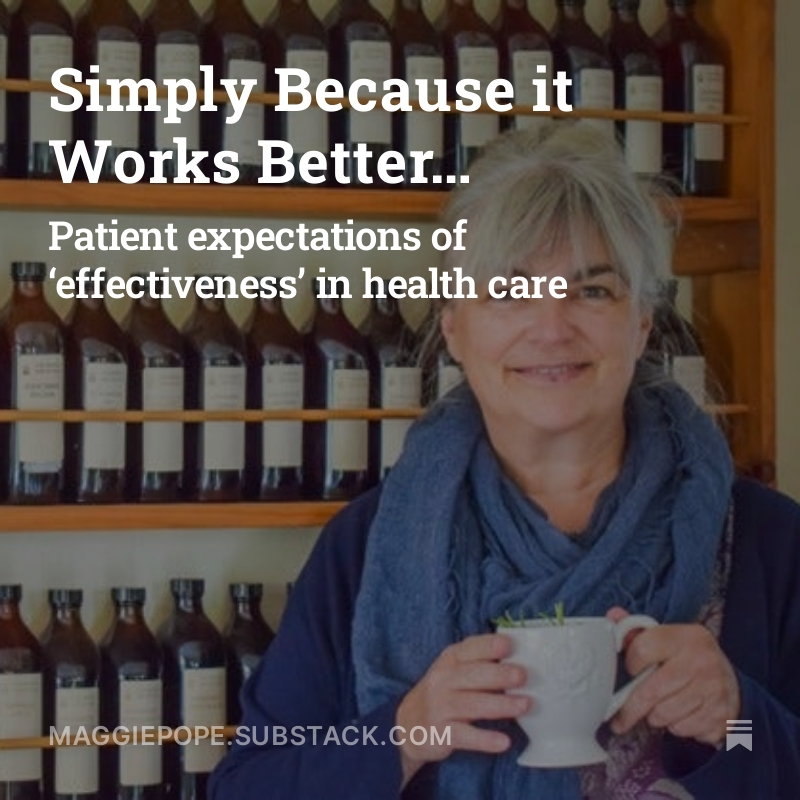
Patient expectations of ‘effectiveness’ in health care
I came across a couple of articles published in 2009 and 2011 by Christine V Little, and although they were published in different years in different publications and have different titles, they are very similar, and sound like they are discussing the results of the same research.
One is called
Patient expectations of ‘effectiveness’ in health care: an example from medical herbalism
The other is called
Simply because it works better: exploring motives for the use of medical herbalism in contemporary UK healthcare.
In summary they conclude that the participants in the study most often were looking for ‘something else’ other than conventional health care to find a model that would ‘more effectively meet their self-perceived needs’ in the treatment of a chronic condition. It seems that they had a different perspective to orthodox practitioners as to what constitutes health care ‘effectiveness’ and chose medical herbalism as it ‘satisfied their expectations of health care because it most readily met their own criteria, and because it had a greater consistency with their own understanding about health, illness and health care’.
What were these criteria?
1. Dealing with illness causation
2. Patient-practitioner collaboration
3. Provision of authentic evidence
It seems that they appreciated going to the cause of their complaint, rather than just having the symptoms addressed; the collaborative nature of the patient-practitioner relationship where their input was respected and listened to; and discussions of why herbs would work for their condition with research to back it up.
In addition, central to their positive response was the ‘therapeutic effect of the herbal therapy itself’, which seems to indicate that it worked.
As a practitioner I would never imply that herbs can replace orthodox medicine, but I would argue strongly they should have a place in modern health care. I think the adjective is integrated medicine. So, is there any relevance to modern clinical practice for the NHS which is running at overcapacity and pumping out pills for chronic conditions that are not improving?
One more quote:
‘The continued popularity of complementary medicine amongst the general public makes its acknowledgement in conventional health care more important than ever. In the context of the integrative health movement, it is therefore essential that health care professionals develop their understanding about patient practices and preferences…’
In other words, it would be nice if GPs, Consultants, nurses etc refrain from making patients feel too scared to mention that they are visiting a medical herbalist. It might just turn out to be a good mix, and the patient’s condition could improve faster.
Perhaps the main benefit we have over NHS staff is that we have time. The time to listen to the whole case history, to listen to all the different symptoms they have been experiencing over month or years and put it all together in one big picture. GPs can’t do this, not because they don’t want to, but because they don’t have time.
Another benefit is that medicinal herbs are nutritive and provide vitamins and mineral alongside the active constituents which provide the actions for the condition being treated, rather than a synthetic concoction made in a factory. [Which I admit, in some cases can be life-saving, or life-improving].
Another benefit is that herbal medicine isn’t addictive.
Another benefit is that medicinal herbs when prescribed in the right dose for the right conditions do not have horrendous side effects, so there is no weighing up of the risk: benefit cost.
And here we come to the main problem: the patient must pay, and they are used to getting their medicines either free or at little cost. Also they might not see results the next day, so it can seem like a shot in the dark.
Perhaps prescriptions from herbalists could be put on the popular ‘social prescribing’ register? I have no idea how this would work but I have had patients drop off treatment because they couldn’t afford to pay for the herbs.
Anybody got an answer for this?
Although I have run workshops which show people how to grow and harvest their own medicinal herbs this will only work for some things. One can’t expect someone who hasn’t been trained as a doctor to know how to insert a canula, in the same way one can’t expect someone who hasn’t been trained as a medical herbalist to know which herbs would make an effective prescription for someone suffering with Crohn’s or a fatty liver…
I was once advised that herbalists should practise under the radar because if we come to the notice of orthodox medicine we would slowly be eased out of service. So, if we become more public, we might get shut down, but if we stay ‘hidden’ no one will find us.
What an interesting position to be in.
