
I am about to go down a rabbit hole…
For the course I am doing I have to write assignments, and as usual, we must read articles, scientific explanations of disease processes, and research papers. At the moment we have been asked to look at the success or limitations of the biopsychosocial model [devised by Engel in 1977] in response to the all-pervading biomedical model which dominates Western culture in three areas i] medical education, ii] research, and iii] clinical practice in mental health conditions.
The biopsychosocial model [BPS] includes taking into consideration the social, emotional, circumstantial and cultural inputs a person experiences when suffering mental health distress, whereas the biomedical model [BS] just looks at the physical brain and the results of tests. If you can’t show it up on a test or image, there is no illness…
In one article that I am reading there are three bold statements that surprised me, and each is prefaced with a commonly held assumption.
- Mental disorders are brain diseases caused by neurotransmitter dysregulation, genetic anomalies, and defects in brain structure and function. Yet, scientists have not identified a biological cause of, or even a reliable biomarker for, any mental disorder.
- Psychotropic medications work by correcting the neurotransmitter imbalances that cause mental disorders. However, there is no credible evidence that mental disorders are caused by chemical imbalances, or that medicines work by correcting such imbalances.
- Advances in neuroscience have ushered in an era of safer and more effective pharmacological treatments. Conversely, modern psychiatric drugs are generally no more safe or effective than those discovered by accident a half-century ago.
Later they write;
‘The labels used to describe newer classes of psychotropic drugs, such as “selective serotonin reuptake inhibitors” (SSRIs) and “mood stabilisers” were conceived in pharmaceutical company marketing departments and have little scientific meaning.’ (Healy, 2012).*
*Healy, D. [2012]. Pharmageddon. Berkeley and Los Angeles, CA: University of California Press.
Wait. What?
If I read this sort of thing in something like ‘Crystal Healing’ or ‘Heal Your Mind with Gongs’ I would have scrolled on by. But this is an article on the reading list for a MSc with the OU. So, who are the writers? They say there is no credible evidence, so, credible to whom?
The article was published in the Clinical Psychology Review, and its title is;
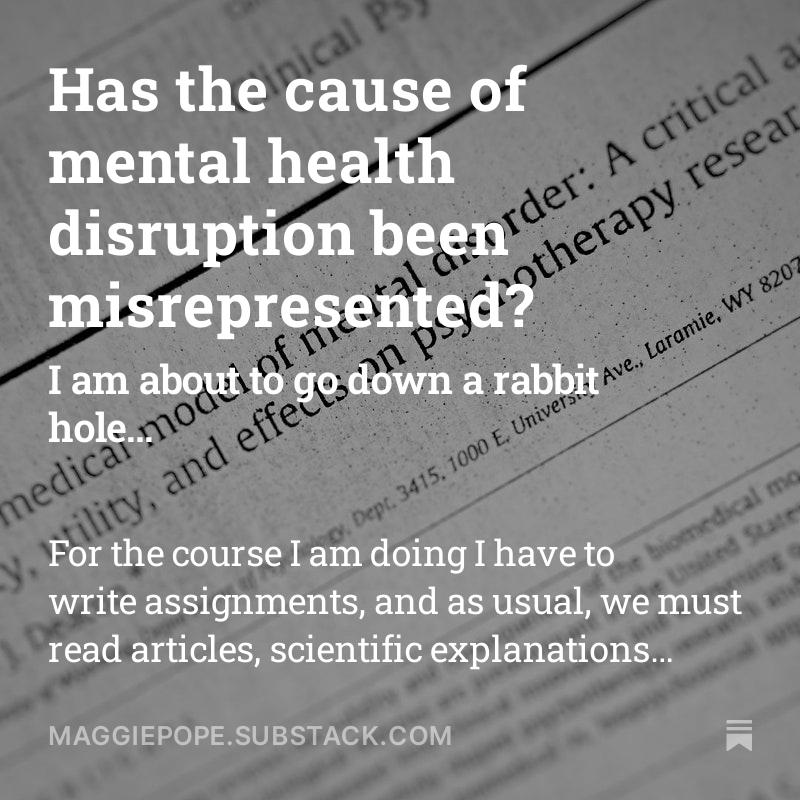
The biomedical model of mental disorder: A critical analysis of its validity, utility, and effects on psychotherapy research. Brett J. Deacon [University of Wyoming. Dept of Psychology].
I know some psychotropic medicine does work. But as Dr Christopher Palmer [a Harvard Consultant Psychiatrist] says in his book ‘Brain Energy’ for many people popping pills isn’t the answer. When medication does work it often comes with side effects, may work well for some years then ‘wear off’ and the patient is back where they started. His interview on Dr Rangan Chatterjee’s podcast is really, really interesting…
The statements made by the author Dr Deacon are significant for me, because when I teach Clinical Medicine I am repeating the education I received at University which was that, for example, chemical imbalances in brain had been shown to be one of the mechanisms that can cause depression and that if there was a lack of serotonin [one of the ‘feel good’ neuro-transmitters] then prescribing SSRIs would rebalance the system, and BINGO!
As a herbalist I don’t try and look for herbs to boost the serotonin levels, but I was relieved to find in module I wrote for our students several years ago, I had said this;
Although these [SSRIs] are prescribed quite freely the scientific consensus is ‘we are not exactly sure how they work’.
I had gone on to develop treatment protocols centred around a nutritious diet to provide the nutrients necessary for health brain function derived from information I had gleaned from the Public Health Nutrition Journal;
A study stated that over 50% of depression is the result of a diet low in nutrients, and that essentially a ‘fast food diet’ is linked to a greater risk of succumbing to depression. This study involved nearly 9,000 participants over 6 months, and concluded that certain nutrients have a protective role against developing depression.
And I am glad to say that I wrote that years before Chris van Tulleken wrote Ultra Processed People.
The more I read about how the pharmaceutical industry involves themselves in the marketing of drugs for mental health disorders the more unsettled I have become. I have had patients wanted to come off the drugs because they cannot stand the side effects, and depending on the state of their mental health, this can be attempted but very slowly, and with a supportive herbal mix and healthy diet in place as they try. Sometimes they have success, sometimes not. What is obvious is that it is not just ‘in the brain’ but the circumstances surrounding the patient must be taken into consideration.
I am at the beginning of delving down into this rabbit hole . The reason I started a masters in Mental Health Science is because my knowledge of the subject was not adequate enough. I think it is going to be a long and interesting road…
