
When the GP isn’t available…
I had a phone call from a stranger today; a mother, sounding tired in the way only parents of poorly children can. Her 18-month-old son had developed a chesty cold, and despite trying, she hadn’t been able to get a GP appointment. She wasn’t looking for anything dramatic, just help, and ideally something she could do without dragging a miserable child out into the world.
Before suggesting anything, I asked the usual safety questions: Was he otherwise well? Any breathing difficulties? High fever? Any other complaints? Was he on any medication? Her answers painted the familiar picture of an ordinary, uncomplicated viral cold. It was unpleasant, but not alarming. He was bunged up, coughing, under the weather, but still responsive and drinking. No red flags. No indication that he needed urgent medical care.
Only then did I offer what she could try at home, using what she already had in her kitchen.
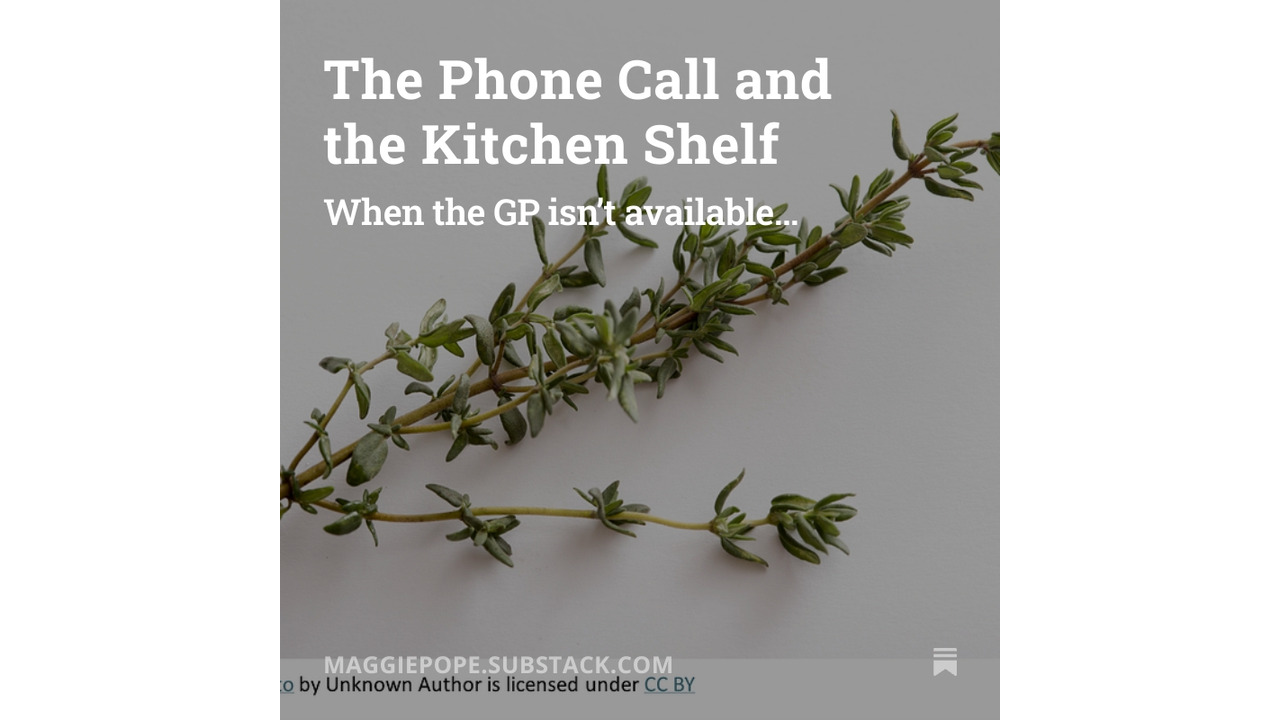
Thyme: the same dried thyme many of us have tucked somewhere behind the olive oil, is a long-standing, sensible choice for chesty colds. It’s soothing, aromatic, and can help loosen congestion. A simple but strong infusion used as a compress 1, can make a real difference to comfort levels. Thyme has a long history in European home medicine for easing chesty colds, the sort where everything feels tight, rattly or stuck. Using it as a warm chest compress is simply a practical way of getting its aromatic qualities close to where they’re needed.
When thyme is steeped in hot water, it releases a set of natural compounds — most notably thymol and carvacrol. These are strongly aromatic and can help loosen congestion and make breathing feel easier. They don’t cure an infection, but they can support the body’s own clearing mechanisms.
And garlic on the feet [which is not magic] but a comforting, practical action many families have relied on. Crushed lightly and wrapped in a thin cloth inside a sock 2, it offers warmth, a sense of doing something, and sometimes a remarkable ability to distract from how wretched a cold can feel. With the important proviso, which I did give her, that garlic can irritate the skin when left directly on delicate skin on overnight.
What struck me wasn’t the thyme or the garlic. It was her relief and enthusiasm. She didn’t have to bundle a poorly child into a car. She didn’t have to sit in a waiting room hoping to be squeezed in somewhere between two already overstretched clinicians. Instead, she had something achievable, immediate and safe.
This is the quiet strength of good, domestic herbal practice: not grand claims, not heroic interventions, but the ability to offer genuinely useful support while knowing exactly where the limits are. My training sits behind every question I ask and every suggestion I make; not to complicate things, but to ensure safety. To know when a child can be cared for at home and when they cannot. To provide reassurance where appropriate and a firm ‘this needs a doctor’ when that’s the case.
There’s also something quietly powerful about helping someone use what they already have. When the health system feels difficult to navigate, small, familiar actions become anchors. A warm compress applied to a child’s chest. The gentle fuss of settling a child for the night.
None of this diminishes modern medicine; it sits alongside it. Most parents aren’t looking to replace their GP. They’re simply trying to bridge the gap between ‘not well’ and/or ‘not an emergency’, especially when the system is under strain. Safe herbal support, guided by proper training, can help fill that space.
I sometimes think we underestimate how important these tiny acts of care are. To a child, they mean comfort. To a parent they mean agency, i.e. the ability to help, to soothe, to do something. That matters, especially on the days when the world feels unhelpful.
In the end, she had a plan for the evening, and her son had a chance to settle, warm, without another disruption. And I was reminded, again, that simple things, used well and safely, can make a bigger difference than we often admit.
If you’ve got thyme in the cupboard and garlic rolling around in a bowl somewhere, you’ve already got a small toolkit for moments like these. Used thoughtfully, with an eye on safety and the common-sense red flags, they can help carry a family through a rough night.
And sometimes, that’s exactly what’s needed.
1How to Make a Thyme Compress (Using Dried Thyme)
- Boil some water.
Bring about 300–500 ml of water to a boil.
- Add the thyme.
Use 1–2 tablespoons of dried thyme. Place it in a heatproof bowl or mug.
- Pour over the hot water.
Cover the thyme completely and let it steep for 10–15 minutes. You want it strong.
- Strain it.
Pour the thyme liquid through a sieve into a clean bowl. You now have your warm infusion.
- Prepare your cloth.
Choose a clean flannel or thin cotton cloth. Dip it into the warm thyme liquid.
- Wring it out.
Gently squeeze out the excess, so it’s warm and damp but not dripping.
- Apply the compress.
Place it on the chest or upper back.
Check the temperature first — it should feel warm, not hot.
- Cover and keep warm.
Lay a dry towel over the top to hold the warmth in place.
- Leave on for 10–20 minutes.
Re-warm the cloth in the thyme liquid if it cools too quickly.
- Repeat as needed.
This can be done 2–3 times a day for comfort and to help ease chest congestion.
2 How to Use Garlic on the Feet (Safely)
1. Prepare the garlic.
Peel 1–2 cloves. Crush them lightly with the flat of a knife — just enough to release the aroma, not enough to turn them into a paste.
2. Wrap the garlic.
Place the crushed cloves in a thin piece of cotton or muslin (a folded handkerchief works well). Wrap it loosely so the garlic is contained but not directly touching the skin. Tuck into a sock. Slip the wrapped garlic inside a clean sock, positioned under the arch of the foot. Or just smear it between two old socks.
4. Put the sock on.
Pull the sock onto the foot so the wrapped garlic stays in place.
5. Check for comfort.
It should feel warm and mild.
If the skin becomes itchy, hot or uncomfortable, remove it straight away.
6. Use for short periods.
Because garlic can irritate delicate skin, especially in children, use it for a couple of hours, and never directly on the skin.
7. Remove and check the skin.
After the session, take it off and make sure the skin looks normal — no redness or irritation.

Just beginning with medicinal herbs?
HerbWorks is a gentle place to start. For £9.99 a month, you’ll receive accessible guidance and simple ways to explore herbal remedies safely at home—no prior knowledge needed. Each monthly live group chat offers a chance to learn, ask questions, and grow your confidence alongside a friendly community. Let HerbWorks support your first steps into herbalism—one calm discovery at a time
