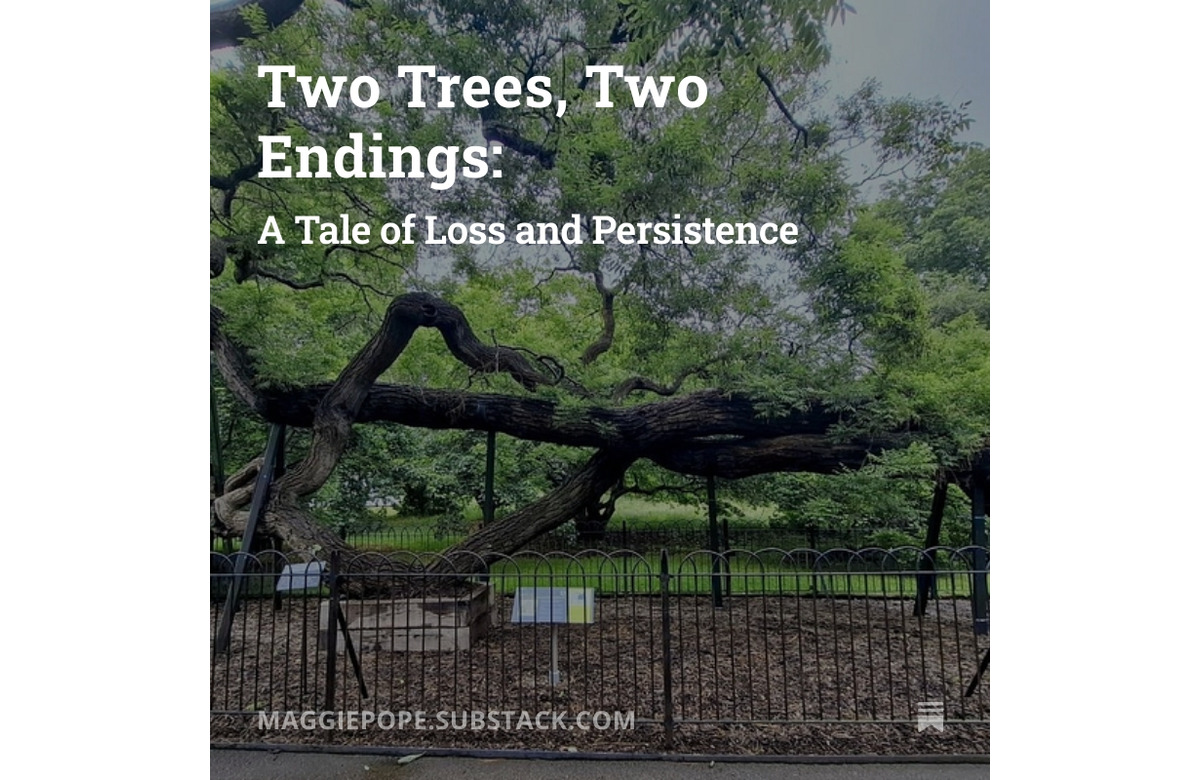
A Tale of Loss and Persistence
Visits to Kew are spectacular; the glasshouses, the architecture, the sheer number of plants, the curated beauty. Visitors take away impressions of the huge leaves in the tropical palm house, the exhilarating experience of the Treetop Walkway, or the interesting Hive structure.
My lasting impression was about two trees.
One is already gone from the world. The other is being held upright by engineered supports, surviving only because people refuse to let it fall. Between them sits a quiet truth about how plant life on earth disappears, and how it can endure.
The first was the St Helena olive, Nesiota elliptica.
Extinct.
Not ‘endangered’, not ‘critically threatened’. Gone.
Kew use the guidelines from the International Union For Conservation of Nature [IUCN] before labelling any plant extinct, so they have good reason. The last living specimen died in 2003 despite years of propagation attempts. Kew’s specimen is no longer an actual plant but a symbolic empty pot, an artefact; something preserved, labelled, and displayed because it cannot be encountered alive anywhere on Earth.
It has become a wood sample in Kew’s Economic Botany Collection, pressed and dried samples in the Herbarium [collected in the 19th Century] and a DNA sample…
Standing in front of the photo of the conservation officer George Benjamin with the last remaining St Helena olive tree before it became officially extinct, I felt the strange uneasiness of looking at a species that has slipped out of existence within my own lifetime.
Extinction is often framed as something ancient or distant, a process belonging to geological time. But the St Helena olive vanished in the era of email, smartphones, and budget airlines. It disappeared quietly, without global headlines, without public mourning, without the world noticing until it was too late.
The St Helena olive is a reminder that what disappears now tends to be what no one is looking at.
Then I saw the Pagoda tree, Styphnolobium japonicum, planted in Kew as part of Princess Augusta’s original arboretum in 1760 [before the USA became a nation state], and hanging by a thread…
This tree, having lived through empires, wars, and the entire arc of industrialisation, now stands only because of human intervention, and only the lower branches survive. Its great limbs are held up by metal structures, braces that counteract gravity and age. It is not thriving; it is being supported by humans who care, who know how important this is. The staff have even left a hand-written note explaining how they are banking up the earth around the trunk trying to encourage new shoots.
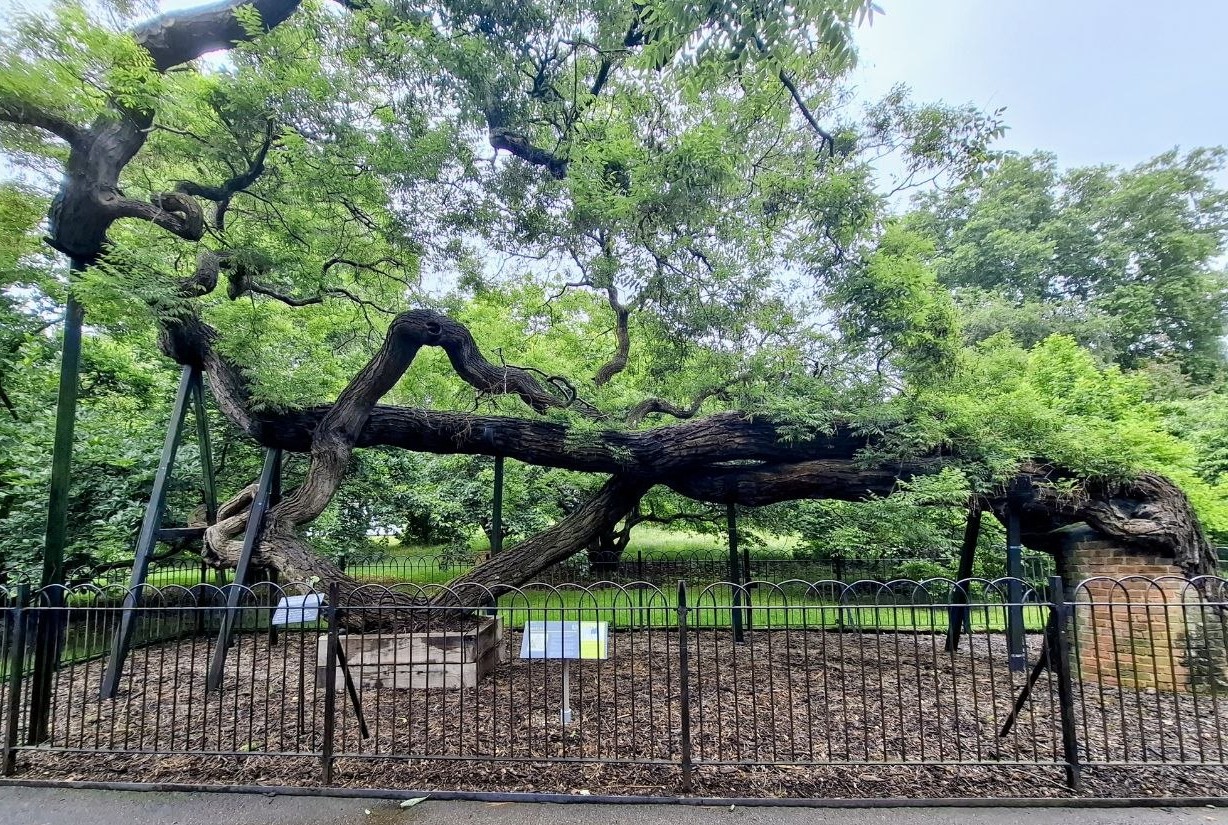
There is something deeply moving about this. The Pagoda tree is no longer simply a botanical specimen. It is a relationship. It survives because people have decided it should. It is a collaboration between centuries of growth and decades of maintenance. Without those supports, it would collapse. With them, it continues to witness the passing of time.
Placed side by side—the extinct St Helena olive and the ageing Pagoda tree—these two encounters form a kind of parable. One species vanished despite human effort. One individual persists only because of it. One shows the limits of rescue; the other shows the possibilities.
But the deeper lesson is that longevity is not protection. The Pagoda tree has endured revolutions, climatic shifts, and the rise and fall of entire world systems. Yet it is still vulnerable to the same forces that erased the St Helena olive: environmental stress, pathogens, the slow erosion of resilience. Age does not guarantee survival. History does not guarantee future.
Kew is often described as a sanctuary, but sanctuaries are not static. They are active attempts to hold back entropy. They require labour, attention, and the willingness to intervene. The St Helena olive shows what happens when the world moves faster than our capacity to protect. The Pagoda tree shows what is possible when we choose to act early enough.
Walking away, I realised that botanical gardens are not just collections. They show us what we have already lost, what we are in danger of losing, and what we might still save if we decide it matters. They remind us that extinction is not a concept but a timeline; our timeline, and that the line is shorter than we think.